This article is written by Abhiraj Jayant (Adv), Partner, Obiter Dicta Legal Solutions LLP and Ms. Tamanna Midha (Adv)
1.1 About Cheque Bounce Cases
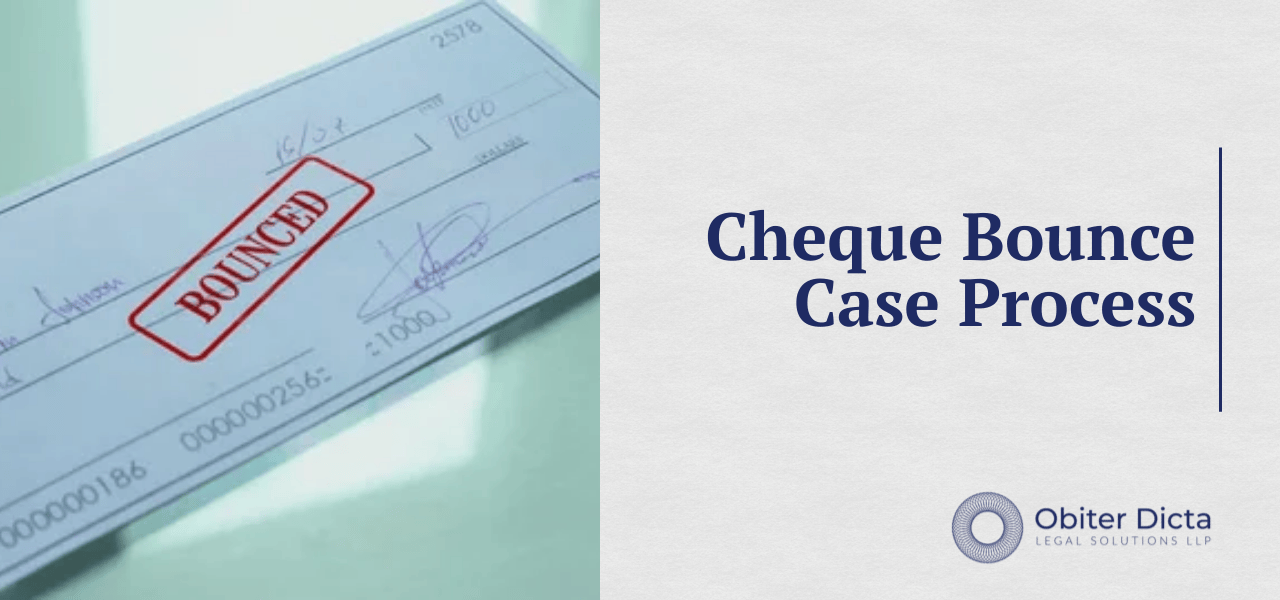
In the sphere of commercial and personal dealings, a cheque represents more than simply a piece of paper; it embodies trust, obligation, and the assurance of payment. A cheque bounce happens when a bank returns a cheque that has been presented for payment, indicating it cannot be processed for some reason. With the notable rise in the financial transactions the cash payments have been replaced with cheques and online transactions.
Cheque bounce cases have become extremely common due to the widespread use of cheques in business transactions, loan repayments, rental arrangements, and personal dealings. To ensure trust and credibility in commercial transactions, the legislature introduced Section 138 of the Negotiable Instruments Act, 1881, to safeguard the rights of individuals. This provision criminalizes cheque dishonor under specific conditions and aims to enhance the reliability of cheques as a negotiable instrument and provide an effective remedy to the payee.
1.2 What is a Cheque Bounce Case?
A cheque bounce, also referred to as a dishonoured cheque, occurs when a bank declines to process a cheque for particular reasons, resulting in the non-payment to the payee. This circumstance may lead to financial detriment and legal difficulties for both the issuer and the recipient.Below mentioned are the common reasons for cheque bounces: –
- There are insufficient funds in the payer’s account.
- A mismatch between the amount in words and digits on the cheque.
- Inconsistencies in the payer’s signature on the cheque and the bank’s records.
- Stale or expired cheques are those that have not been deposited into a bank within three months of the date of issue, and banks are not compelled to honour them, resulting in a cheque bounce.
- Compromised cheques (either writing is illegible/not readable or cheque damaged in itself) thereby, not honoured by banks.
1.3 Legal Framework Governing Cheque Bounce Cases
Bounced Cheques or Dishonored Cheques are considered as criminal offence primarily governed by the Negotiable Instruments Act, 1881, particularly Sections 138-147. The provisions as mentioned lays down the procedure, offence, compounding of offences, and presumption of liability.
1.4 Essential Ingredients of a Cheque Bounce Case
Section 138 of the Act specifies the circumstances under which a case of cheque dishonour can be filed. There are certain ingredients of Section 138, Negotiable Instruments Act, 1881 and are as mentioned below: –
1. The cheque for a specified amount is issued by the drawer to the payee or complainant from a bank account maintained by the drawer.
2. This cheque is issued to discharge debts or liabilities, in whole or in part.
3. The cheque is dishonoured by the bank due to insufficient funds to honour it or because it exceeds the amount authorised for payment from that account under an agreement with the bank.
4. The cheque must be presented within 3 months of the draw date or during its validity term.
5. The payee or holder issues a 30-day demand notice upon receiving information from the bank about the dishonoured cheque.
6. The drawer of the cheque fails to pay the specified amount of money to the payee or holder within 15 days of receiving the notice.
7. The debt or liability for which the cheque was issued is legally binding.
8. Failure of the drawer to make payment within 15 days of receiving the notice.
1.5 Cheque Bounce Legal Notice
A cheque bounce notice is a legal notice given to the issuer of a bounced cheque requesting payment. It is issued pursuant to Section 138 of the Negotiable Instruments Act of 1881 when a cheque is dishonoured due to inadequate funds in the issuer’s account. The drawer has 15 days to make payment after receiving the notice, which is sent to the individuals within 30 days of the cheque bouncing.
1.6 Filing a Cheque Bounce Complaint
When a cheque is returned due to a lack of sufficient funds, the drawer can be held criminally liable in accordance with Section 138 of the Negotiable Instruments Act. The drawer may face a fine of up to twice the amount of the cheque, up to two years in prison, or both. The court may also initiate legal proceedings against the payee for the amount specified on the cheque.
If payment is not received within the specified 15 days, a criminal complaint in the magistrate’s court may be filed that has jurisdiction where the cheque was presented. The complaint needs to be filed within 30 days following the end of the 15-day period.
The following documents are required to file the complaint:
•The cheque that was originally dishonoured
•The memo regarding the return from the bank
•A copy of the notice sent to the drawer
•The acknowledgement receipt (or postal receipt) indicating that the notice was dispatched
1.7 Procedure of Cheque Bounce Case in Court
•Filing of the Complaint:- The complaint must be filed with the jurisdictional magistrate within 30 days of the cause of action arising. The complainant must be present before the magistrate at the moment of filing. The original documents must be shown to the magistrate.
•Pre Summoning Evidence:- At this point, the complainant must go into the witness box and provide more case-specific information. If the magistrate is convinced that there is some merit to the complainant’s case, he shall issue a summons to the accused.
•Issuance of summons:– The accused must show up in court after receiving a summons. The court will issue an arrest warrant against him if he fails to show up.
•Plea of the accused:– In the following phase, the accused will be asked by the court if he has committed the crime. If the accused accepts guilt, the court will punish him immediately. If he pleads innocent, the court will open the case for evidence.
•Evidence stage:– The Complainant must provide evidence, usually in the form of an affidavit, which is known as examination-in-chief. He is required to produce all supporting documents for his case, such as the invalid cheque, dishonour memo, copy of the notice, etc. Subsequently, the complainant will be cross-examined by the accused. Following the accused’s statement, an opportunity would be provided to the acussed by the court to provide evidence. The evidence can be in document form or even witnesses can be called. Accused and his witnesses will be cross examined by the complainant. After this, the case is posted for arguments.
•Final arguments and judgment:- Both the complainant and the accused would proceed with the final arguments. The court would hear both the sides. If the court determines accused guilty, he will be punished with the fine, or imprisonment, or both.
1.8 Punishment and Compensation in Cheque Bounce Cases
If a cheque is dishonoured and the drawer fails to make payment despite receiving the statutory notice, the court may impose the following penalties pursuant to Section 138 of the Negotiable Instruments Act, 1881:
-Imprisonment – Up to 2 years.
-Fine – Up to twice the cheque amount.
-Both – The court can award both imprisonment and fine together.
In addition, courts may award compensation under Section 357 of the Criminal Procedure Code. In practice, courts focus more on compensation than imprisonment to ensure recovery for the complainant.
1.9 Compounding and Settlement of Cheque Bounce Cases
The present offence is bailable, compoundable, and non-cognizable. This means that the issue can always be resolved (compounded) between the parties at any stage.
The Supreme Court has recently revised the guidelines for compounding dishonour of cheque cases under Section 138 of the Negotiable Instruments Act, 1881, in the judgment of Sanjabij Tari vs Kishore S. Borcar & Others, 2025. The Supreme court of India introduced a stage-wise compounding mechanism for cheque bounce cases under Section 138 of the Negotiable Instruments Act, 1881, with the objective of prioritizing payment over punishment and reducing pendency.
At the trial court stage, courts are encouraged to facilitate early settlement, and interim compensation may be directed under Section 143A of the NI Act. At the appellate or revisional stage before the Sessions Court or High Court, compounding is permitted upon payment of 7.5% of the cheque amount as costs. If compounding is sought before the Supreme Court, the cost increases to 10% of the cheque amount.
1.10 Defences Available to the Accused
There are certain defences which can be taken up by the accused under NI Act, 1881 and are as mentioned below: –
-Absence of legally enforceable debt
-Cheque issued as security
-Non-service of legal notice
-Misuse of cheque
-Bar of limitation
The burden of proof lies on the accused.
1.11 Cheque Bounce Cases Involving Companies and Directors
In cases of cheque dishonour under Section 138 of the Negotiable Instruments Act, the company as a separate legal entity is primarily liable for the offense.
However, under Section 141, directors can be held vicariously liable if they were “in charge of” and “responsible to” the company for the conduct of its business at the time the offense was committed. To successfully prosecute a director, the complainant must provide specific pleadings (averments) detailing their active role in the default; mere signatures or a high-ranking title like “Director” are not always sufficient for criminal liability.
A common mistake in arraying parties is failing to name the company itself as an accused, which is a mandatory prerequisite for maintaining a case against its directors. Additionally, complainants often erroneously include “Independent” or “Non-Executive” directors who have no involvement in day-to-day financial operations, leading to those proceedings being quashed by the courts.
1.12 Practical Tips for Complainants
For successful prosecution in the cheque bounce cases, there are some tips which needs to be keep in mind as mentioned below: –
–Drafting strong legal notices: Make sure that the notice clearly specifies the cheque details, amount specified, reason for dishonour, & proper demand for repayment of money within the stipulated time period.
–Maintaining Documentary Proof: Ensure that you have documentary proof for your claim. Preserve the original cheque, legal notice, bank return memo, and proof of service.
–Avoid common procedural mistakes: Strictly adhere to statutory timelines and jurisdictional requirements to prevent dismissal on technical grounds.
–Importance of Timely legal action : Keep in mind the time framework for each of the process.
1.13 Conclusion
Cheque bounce cases under Section 138 of the Negotiable Instruments Act provide an effective mechanism to protect the rights of payees and ensure recovery of legally enforceable dues through criminal and compensatory remedies. However, the success of a recovery claim is entirely dependent on adhering to regulatory deadlines and providing correct documentation. Any procedural error has the potential to undermine a complainant’s case and result in its dismissal. Potential complainants should therefore give priority to early legal consultation. Seeking timely legal assistance is critical to attaining an effective and rapid recovery while avoiding procedural pitfalls.
FREQUENTLY ASKED QUESTIONS (FAQs)
Q.What is the time limit to file a cheque bounce case in India?
The case has to be filed within 30 days after the expiry of the 15-day notice period.
Q. Is cheque bounce a criminal offence or civil offence?
Primarily, it is a criminal offence under Section 138 of the NI Act, though simultaneously a civil suit for the recovery of the money
Q. Can a cheque bounce case be settled out of court?
Yes, cheque bounce offence is compoundable in nature i.e., it can be settled outside the court through alternative dispute resolution systems, for example- mediation.
Q. What happens if the legal notice is not replied to?
Failure to respond does not end the case; rather, it allows the complainant to launch a court case immediately after 15 days and may be interpreted by the court as an implied admission of the debt.
Q. Is imprisonment mandatory in cheque bounce cases?
Generally, the court priorities monetary compensation, or fine over imprisonment. Thereby, imprisonment is not mandatory.
Q. Can a cheque given as security attract Section 138 NI Act?
No, the cheque given as security attract does not attract Section 138 NI Act, it is a defence which is usually taken up by the accused.
Q. How long does a cheque bounce case usually take in India?
The duration of the case depends upon various factors such as conduct of the parties, court workload, and settlement efforts. Generally, it takes around several months to few years.
Q. Can a director be held personally liable in a cheque bounce case?
Yes, the director can be held vicariously liable under Section 141 of the NI Act, 1881.
Q. What if the cheque bounces due to “stop payment” instructions?
“Stop payment” instructions do not immediately discharge obligation. If the cheque was written to pay off a legally enforceable debt, Section 138 may still apply, but only if there is proof of intent and the circumstances surrounding it.
Q. Can a cheque bounce case be filed online?
As of now, this complaint is generally required to be filed physically, but some courts allow e-filing or online submission of documents through e-courts initiative.
Q. Is mediation possible in cheque bounce cases?
Yes, as it is a compoundable offence, thereby mediation is possible.