This article is written by Abhiraj Jayant, Advocate (Partner, Obiter Dicta Legal Solutions LLP) and Ms. Tamanna Midha (Advocate)
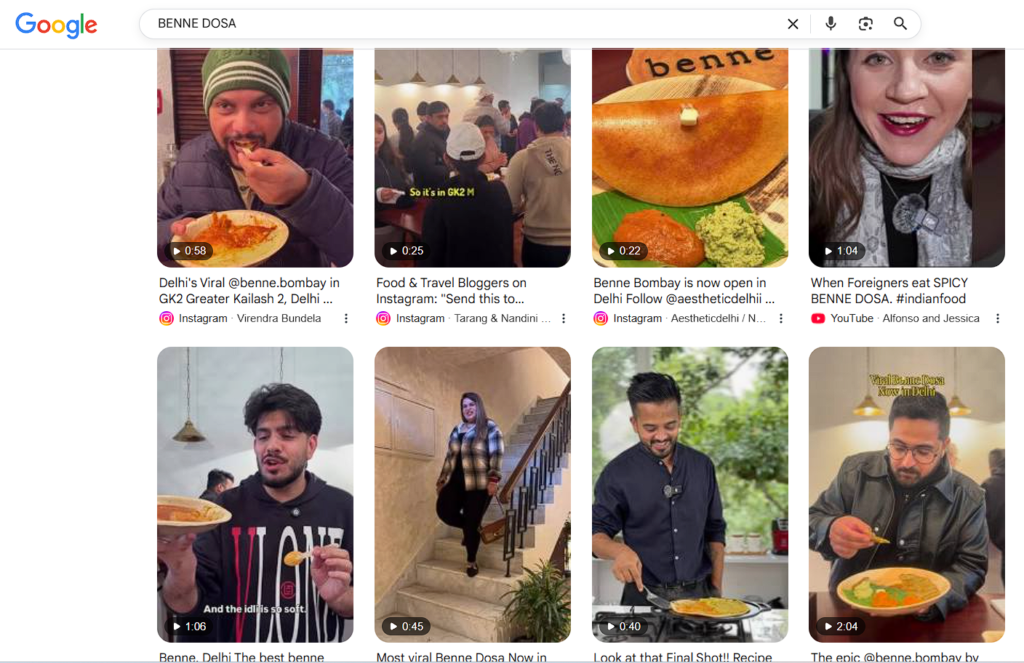
Of late, “Benne Dosa”, the restaurant in Greater Kailash–II, South Delhi, has been dominating Instagram reels and food vlogs, with visuals of long queues, sold-out counters, and patrons patiently waiting to get a taste of its much-talked-about dosas. The buzz is unmistakable, what began as a regional delicacy has now found a devoted following in the capital, turning the outlet into a must-visit destination for food enthusiasts. While the culinary popularity of Benne Dosa is evident, what particularly caught my attention was not the dosa itself, but the word “Benne.” Curiosity led me to dig deeper into its meaning, usage, and legal character, only to discover that “Benne” is, in trademark terms, a weak mark, raising important questions about its protectability and exclusivity. My analysis follows below.
Dosa-A popular Dish in India
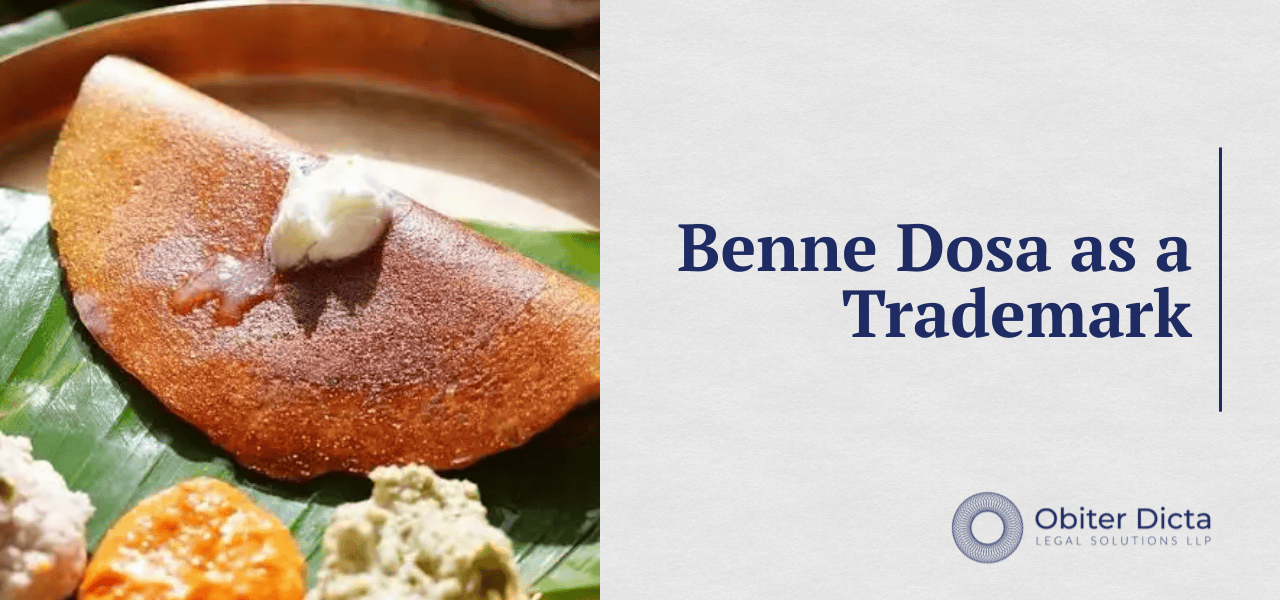
Dosa has been amongst the perfect breakfast option for every Indian. One of its kind i.e., ‘Benne Dosa’ has gained popularity since few years and has turned out be everyone’s favourite. “Benne Dosa” is a popular South Indian dish distinguished by the use of generous and excessive amounts of butter as “benne” in Kannada, means butter. The term “benne” has origin from Kannada language, which means “butter” and “Dosa” is a generic term referring to a fermented crepe-like pancake made from the batter of rice and lentil origin, and is widely recognized in India.
While benne dosa is a popularly known regional food item from Karnataka, the present research discusses whether the term can work as a source identifier for commercial services or products and thereby meet the requirements of Indian trademark law. This article examines the registrability of “Benne Dosa” as Trademark in India under Class 30 and Class 43 of Trade Marks Act, 1999 by examining the legal, linguistic, and practical dimensions.
ETYMOLOGICAL SIGNIFICANCE OF TERM “BENNE”
In Kannada, the term “benne” literally translates to “butter” because of its characteristic preparation method involving a massive amount of butter being smeared on to the dosa when preparing it, originating form regions i.e., Davangere and Bengaluru.
This term is not merely descriptive but also culturally ingrained in Karnataka’s culinary heritage, where “Benne Dosa” has attained widespread popularity, frequently prepared and sold across various districts, thereby rendering it arguably generic in character.
LEGAL FRAMEWORK FOR TRADEMARK REGISTRATION
The Indian trademark legislation restricts the registration of marks that lack distinctiveness or are merely descriptive of the goods or services, as outlined in Sections 9(1)(a)-(b) and 11. For the purpose of this article, Class 30 is relevant where Benne Dosa is sought to be registered for food products such as batter or ready-to-eat items, while Class 43 applies when the mark is used for restaurant or food service businesses.
CAN IT BE REGISTERED AS A RESTAURANT NAME?
“Benne Dosa” encounters considerable challenges in securing registration as a restaurant name under Section 9(1)(b) of the Trade Marks Act, 1999, which prohibits registration to marks lacking distinctive character or comprising solely of signs that describe the nature, quality, quantity, or other attributes of the services. The mere descriptive or generic application of a popular term is typically not registrable unless it has attained secondary meaning through extensive use, thereby demonstrating distinctiveness. As the term, Benne dosa, is a descriptive term, thereby lacks distinctiveness.
In the realm of food and hospitality services, Indian trademark jurisprudence has persistently maintained that names simply describing the cuisine or dishes offered are intrinsically weak and typically non-registrable unless they have attained secondary meaning. The extensive and traditional consumption of benne dosa by numerous establishments throughout Karnataka and other regions of India underscores its descriptive and potentially generic nature. Consequently, consumers are more inclined to interpret the term as referring to a category of dish rather than as indicating a specific restaurant or business entity.
However, registration may still be possible if Benne Dosa is used as part of a composite mark, like when it is combined with unique elements, trade names, logos, or stylized representations. In these situations, the mark’s distinctiveness may come from the overall impression it makes rather than from the descriptive term itself. An applicant may also try to show that the mark has acquired distinctiveness by showing that it has been used for a long time, continuously, and exclusively, along with proof of consumer recognition and goodwill. So, even though Benne Dosa as a standalone restaurant name faces a lot of legal hurdles because it is descriptive, it may be possible to get limited trademark protection through smart branding or proof of acquiring secondary meaning.
The existing applications support this point, for example: –
- Composite marks like “DVG Benne Dosa Live the Butter Life” (Application No. 4080191, filed 07-02-2019) incorporate additional distinctive elements to overcome descriptiveness and get itself registered.
It is unlikely that “Benne Dosa” can be registered as a restaurant name without having gained distinctiveness through extensive use, since it directly describes the main dish on the menu.
Registrability of “Benne Dosa” as a Dish Name
It is even less likely that the dish “Benne Dosa” will be registered as a trademark for a dish name, because it is general and descriptive. Section 9(1)(b) and Section 36(2) bars protection for those terms which have become customary in trade, The name “Benne Dosa” is a descriptive term, and it clearly describes products essential characteristics, i.e., a dosa made with butter (generic term). So, when used for food products like ready-to-eat dosas or batter mixes under Class 30, the word doesn’t make it easy to tell one trader’s goods from another’s. In trademark law, generic food names like dosa, idli, or vada are not protected and can be used by anybody. In the same way, benne dosa is the name of a dish not a badge of origin. Unless there are special conditions that show that the term has taken on a secondary meaning that is only linked to one source, it is doubtful that it will be registered as a dish name. Also, the fact that it is made in many districts of Karnataka makes it less unique and more like a generic item. So, “Benne Dosa” can’t be the only name for a dish because it is still in the public domain.
RISING NUMBER OF TRADEMARK APPLICATIONS FOR “BENNE DOSA” IN CLASS 43
The Indian Trade Marks Registry database shows that there are many applications that include “Benne” in Class 43 (restaurant, café, catering, and food services). This shows that there is a lot of competition for exclusivity over the word “Benne”.
An examination of the IP India Trade Marks Registry database for the term “Benne” within Class 43 (services for providing food and drink) indicates an increasing trend in applications aimed at securing protection for restaurant and food service marks that include the term benne. The search results reveal that the initial application for a mark featuring “Benne Dosa” or “Benne” in Class 43 originated in 2018, with the mark “Davanagere Benne Dose” being filed for restaurant services and currently registered.
From 2023 to 2025, there is a clear increase in trademark applications. This shows that more businesses are interested in branding with benne dosa. Numerous applicants have sought to register trademarks that include “Benne”, “Benne Dosa”, or similar variations, frequently in conjunction with supplementary terms, geographic designations, or slogans.
| Application No. | Mark Name | Filing Date | Status/Details | Goods & Services |
| 3868579 | DAVANAGERE BENNE DOSE | 23-06-2018 | Registered | Services rendered in the field of providing foods and beverages. |
| 7270229 | 99 BenneDosa | 03-10-2025 | Formalities Check Pass | Foods and Beverages such as Dosa, Coffe, Idli etc. |
| 7319756 | Benne Dosa Table Butter Batter Binge | 03-11-2025 | Formalities Check Pass | Restaurants, Café, Catering, and Food Delivery Services |
| 6996062 | Bangalore Benne Dosa-BBD Classic South Delights | 07-05-2025 | Formalities Check Pass | Restaurant services for the provisions of fast food and cafe |
| 7042210 | U2M Benne Dosa | 03-06-2025 | Formalities Check Pass |
At least four key applications since 2013, with four in 2025 alone, show surging interest.
PROBABLE OUTCOME of “BENNE” TRADEMARK APPLICATIONS
The most likely outcome is that “Benne Dosa” will not be granted exclusive or standalone trademark protection, as it is inherently descriptive and generic in nature, falling squarely within the prohibition under Section 9(1)(b) of the Trade Marks Act, 1999. At best, any protection that may be afforded would be limited to a composite or stylized mark, accompanied by an express disclaimer over the words “Benne” and “Dosa.”
This case serves as a timely reminder that commercial success and social media virality, however impressive, do not automatically translate into proprietary trademark rights. Terms that are rooted in language, culture, and common trade usage must remain available for all traders to honestly describe their goods. While branding can certainly elevate a regional delicacy to national fame, trademark law draws a clear line between distinctive source identifiers and descriptive expressions that belong to the public domain. In the long run, it is not the name alone but the overall brand presentation, quality, and consumer experience that can lawfully earn protection.
Thank You for Reading!
Any other Questions?
Reach out to us on +91-9217114811 Or email us at MAIL@OBITER.IN