
This article is written by Abhiraj Jayant, Advocate and Ms. Trisha Chatterjee
The application of drones has significantly increased in recent times in various sectors in Indian society. What has primarily been a function of hobbyists is rapidly transitioning into commercial services such as aerial photography, land surveying, inspection of infrastructure, agricultural land monitoring, management of disasters, and even delivery services. Some government measures and innovations are subsequently propelling the integration of unmanned aircraft systems into the digital and economic development of Indian society. As such, it is essential to be well-versed in drone regulations, not merely as a way to circumvent the law but also in order, in effect, to operate in an ethical, safe, and acceptable manner in India
1.1 What Regulations govern Drones in India?
The regulation of drone flying in India is mostly under the regulation of the Directorate General of Civil Aviation, which is under the Ministry of Civil Aviation of the Government of India. The Directorate General of Civil Aviation is the regulatory body responsible for the regulation of civil aviation, including Unmanned Aerial Vehicles. The regulatory framework is mainly comprised of the Drone Rules, 2021, which have been simplified and liberalized by amendments and notifications issued in 2022. The regulatory framework classified the drones on the basis of their weights and uses and has addressed the issues related to ease of business, safety, and security concerns through the Digital Sky Platform.
1.2 What Drones are legal in India?
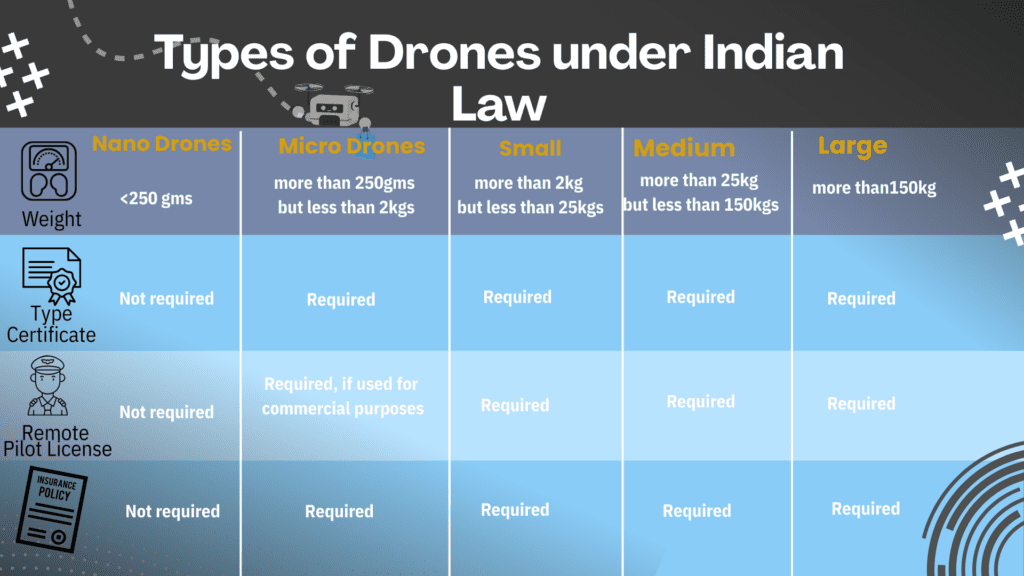
Indian law categorizes drones into five categories, namely Nano, Micro, Small, Medium, and Large, based on maximum take-off weight. Nano drones are normally used for recreational purposes, while the larger categories are often deployed for commercial and industrial operations. Drones that comply with DGCA technical standards and registration requirements are considered permissible for operation. Still, not all drones are legal. It’s illegal to bring into the country and fly drones without required safety features, and also those that are not registered, or whose imports are in direct contravention of trade regulations.
On a related note, DGFT has forbidden any imports of foreign drones , except in limited cases for research, defense, and government uses. This means the popular foreign brands like DJI cannot be bought legally through new imports in India. Operators have to ensure the drone’s hardware and firmware are compliant, unauthorized modifications may render the drone illegal and expose the operator to penalties. It is worth pointing out here that the DGFT Notification regarding the prohibition on the import of foreign drones has a prospective effect. Hence, foreign-made imported drones, which were properly purchased in India prior to the 2022 DGFT Notification, will be considered valid and are free to be used in India provided they are registered with the Digital Sky Platform. It can be seen, therefore, that the ban primarily affects foreign imports post-notification. It does not cancel foreign-imported drones purchased prior to the Notification.
1.3 Key Definitions (for Legal Clarity)
An Unmanned Aircraft System (UAS) is defined as a UAS consists of a drone, operational components, such as a remote control, communications, and operational software. In this case, it comprises both the aircraft and the control.
Remote Pilot is a person trained and licensed to control a drone, whereas Operator is a term used to address a person or organization responsible for managing and performing drone operations.
Visual Line of Sight (VLOS) is where the remotely operated vehicle must remain in plain sight with the pilot as long as it is not necessary to use binoculars or cameras. Beyond Visual Line of Sight (BVLOS), where the vehicle travels out of the pilot’s plain sight, is as yet prohibited and only permitted in legitimized governmentauthorized trails and exemptions.
1.4 Registration Requirement
It is a misconception spread by social media and uninformed articles that Nano Drones are not required to be registered. However, nothing could be further from the truth. According to the provisions of the Drone Rules 2021, all categories of drones are required to be registered on the Digital Sky Platform.
Parameters such as specifications, details about the company that manufactured the drone, as well as the serial number and ownership details, must be provided by the applicant. After approval, the drone is assigned a Unique Identification Number that must also be clearly marked on it. A certificate of registration is also given and is normally valid for a certain period until it is revoked due to contraventions.
1.5 Drone Pilot Training and Licensing
If anyone wishes to operate a micro , small, medium or large drone, they are required to obtain a Remote Pilot License from DGCA (Director General of Civil Aviation) approved training institutes. The List of Training Institutes can be found on the website of Digital Sky. (This link was working as of 13.01.2026)
Remote Pilot License is not required in the following scenarios:
-If you wish to fly a Nano Drone
-If you wish to fly a Micro Drone for non-commercial purposes.
Procedure to get Remote Pilot License:
- Undergo training at DGCA approved Training Institutes
- Upon completion of training, pass the assessment test held by the Institute.
- The Institute will file the form D-4 on your behalf on the Digital Sky Platform. (Has to be done within 7 days from passing of the assessment)
- The License will be issued online within 15 days on the Digital Sky platform.
1.6 Where and How High Can You Fly a Drone?
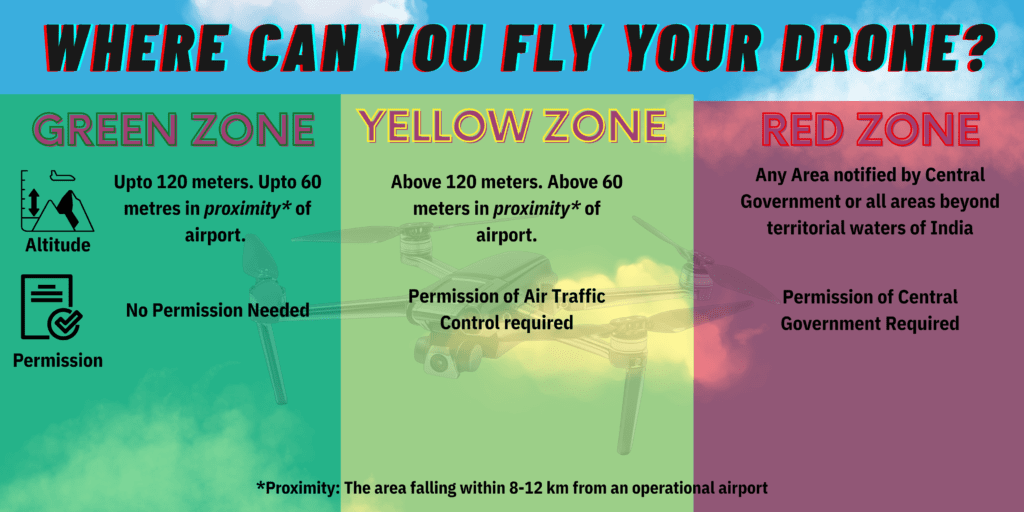
Drones in India have restrictions of altitude and geographical area to ensure safety in the airspace. Essentially, drones are freely allowed to fly under 120 meters or 400 feet above ground level. Beyond 120 meters, is considered as Yellow Zone and requires permission of Air Traffic Control
The Indian airspace has been demarcated into various zones such as Green Zone, Yellow Zone and Red Zone. The marking of these zones is visible on the Digital Sky platform on a real time basis and drone operators are advised to refer to these live maps before starting the drone’s journey in order to avoid accidental trespass into yellow or red zones.
Drones can operate freely in Green Zones. Whereas they require permission from the Air Traffic Control to operate in Yellow Zones and permission from the Central Government for operating in Red Zones.
1.8 Other Important Legal Obligations
Other Legal Considerations for Operation of Drones
Apart from compliance with aviation and operational guidelines, drone operators must also be mindful of several ancillary legal obligations that arise from the use of unmanned aircraft systems, particularly in relation to accidents, insurance, liability, and privacy.
Reporting of Accidents
In the event of any accident involving a drone—whether resulting in injury to persons, damage to property, or loss of the drone itself—the incident must be reported to the concerned authorities within 48 hours of its occurrence. Timely reporting is essential to ensure transparency, enable investigation, and comply with statutory requirements under the applicable drone regulations.
Mandatory Insurance
All drones must be adequately insured before being operated. Insurance coverage is essential to safeguard against third-party risks, including bodily injury, death, or property damage caused due to drone operations. Operating a drone without valid insurance may expose the operator to civil liability and regulatory penalties.
Liability and Compensation in Case of Accidents
Where a drone accident results in injury, death, or damage to property, the liability and compensation payable shall be determined in accordance with the principles laid down under the Motor Vehicles Act, 1988, as applicable. This ensures a structured and standardized mechanism for assessment of compensation, particularly in cases involving third-party claims.
Privacy and Data Protection Concerns
Drone operations involving photography, videography, or surveillance must strictly adhere to privacy laws. Capturing images or videos of individuals without their consent may amount to an invasion of privacy and could attract legal action under applicable laws.
Further, misuse of drones for unlawful monitoring, harassment, or tracking of individuals may attract criminal liability under provisions relating to stalking, as well as under the Information Technology Act, 2000, if electronic data or images are used for illegal or malicious purposes. Drone operators must ensure that data collected is lawful, proportionate, and used only for legitimate purposes.
Misuse and Penal Consequences
Any use of drones for illegal activities, including unauthorized surveillance, data theft, intimidation, or other unlawful acts, can lead to serious penal consequences under various criminal and cyber laws in addition to regulatory action under drone-specific regulations
1.9 Penalties for Non- Compliance
Unauthorized operation of drones without registration, operating them without authorization, and violating restrictions regarding altitude and airspace may attract punishment in the form of fines, confiscation of the drone, revocation of licenses, and prosecution under aviation and criminal statutes. There have also been actual cases documented in the media where people have been arrested or fined for operating drones near airports, the border, or an event without the necessary clearance. This is conducted not only by the DGCA but also by the police and other law enforcement agencies, particularly in restricted zones.
1.10 Practical Tips Before You Fly
Drone operators should, therefore, check NOTAMs (Notices to Airmen) and airspace updates before planning any particular flight. The use of authorized applications and Digital Sky Platform ensures accurate information regarding airspace. Principles of keeping good flight records, respecting property rights, and adhering to administrative regulations can go a long way in steering clear of any legal issues. Acting responsibly while flying is not only a matter of complying with the law but also of upholding morality.
1.11 Conclusion
Drone laws in India are relatively nascent and are expected to evolve continuously as new challenges and opportunities emerge with advancements in technology and increasing use cases. Accordingly, any person or entity intending to operate drones in India must remain well-informed about the applicable laws and regulations issued by the Directorate General of Civil Aviation (DGCA), along with relevant notifications and directions from law enforcement authorities and air traffic control agencies.
As the deployment of drones expands across businesses and commercial industries on a larger scale, regulatory compliance and legal risk mitigation will become critical considerations. Adherence to the prescribed legal framework will not only ensure lawful operations but also help in minimizing liability, safeguarding public safety, and fostering sustainable growth of the drone ecosystem in India.