
The process of trademark registration in India involves several stages designed to ensure that the mark is distinctive, original, and does not conflict with existing rights. Broadly, the journey can be divided into key parts such as filing of the application, examination and objections, advertisement in the Trademark Journal, and, where applicable, opposition proceedings.
However, it is not mandatory for every trademark to go through all these stages—many marks are accepted without objections, and many pass through journal publication without any opposition.
Entire Process of Trademark Registration in India-Explained through a Flowchart
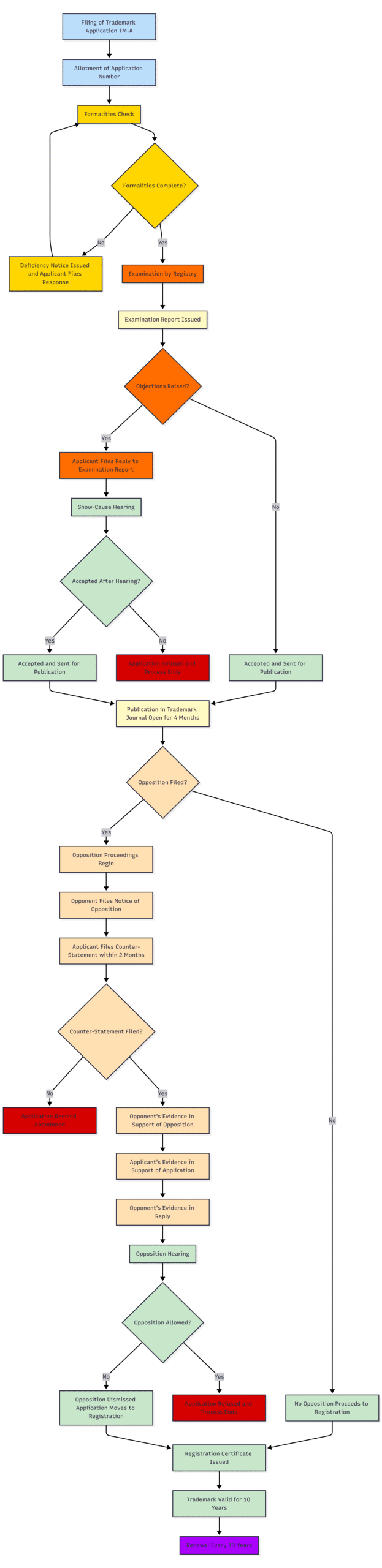
Detailed Explanation of the process
The process begins with filing the trademark application (Form TM-A) before the appropriate jurisdictional office of the Trade Marks Registry. Once filed, the application undergoes a formalities check to verify the accuracy of the filing details, classification, and supporting documents. If found complete, the application proceeds to examination, where the Registrar evaluates it on absolute and relative grounds of refusal. If objections are raised, the applicant is given an opportunity to submit a written reply, followed by a hearing if necessary.
If the Registrar is satisfied, the trademark is accepted and advertised in the Trademark Journal. The publication opens a four-month opposition window, during which any third party may oppose the registration. If an opposition is filed, the matter proceeds before the Registrar through pleadings, evidence rounds, and an oral hearing. If no opposition is filed—or if an opposition is ultimately dismissed—the trademark proceeds to registration, after which a Registration Certificate is issued. The registered trademark is valid for 10 years and can be renewed indefinitely in 10-year cycles.
Frequently Asked Questions
Q. How much time does it take for the trademark registration process?
The time taken for trademark registration in India varies depending on the workload and pendency at the relevant Trade Marks Registry office. While there is an option to file for expedited examination, which accelerates the examination stage, the overall process still depends on factors such as whether objections or oppositions arise.
For straightforward applications with no objections and no oppositions, registration can still take up to one year. If objections or opposition proceedings occur, the timeline may extend significantly.
Q. What are the fees incurred for trademark registration in India?
The overall cost of obtaining trademark registration includes two main components:
Government Fees and Professional Fees.
- Government Fees
These are statutory charges payable to the Trade Marks Registry at the time of filing the trademark application. The government fee varies based on the category of the applicant (individual/startup/small entity vs. others) and is applicable per class. In addition, if any further requests or forms are required—such as applications for amendment, renewal, expedited examination, or extensions of time—each of these filings also attracts separate government fees as prescribed under the Trade Marks Rules. - Professional Fees
These fees vary from attorney to attorney and are typically charged per trademark per class. Professional fees
may also be payable separately for:
- Preparing and filing replies to office objections (Examination Report)
- Drafting and filing counter-statements or other pleadings in opposition proceedings
- Preparing evidence and attending hearings before the Registrar
- Drafting additional requests or handling procedural filings during the course of the application
Because every case is different, the total cost ultimately depends on the number of classes, complexity of the mark, and whether objections or oppositions arise during the process.
Q. What is the process of trademark registration in India?
The process includes trademark search, filing, examination, responding to objections (if any), publication in the Trademark Journal, opposition proceedings (if filed), and finally registration.
Q. What is the government fee for filing a trademark application?
The government filing fee depends on the applicant category (Individual/Startup/Small Enterprise or Others) and is payable per trademark per class.
Q. What is the professional fee for trademark registration?
There are two components: Government Fees and Professional Fees. Professional fees vary from attorney to attorney and are generally charged per trademark per class. Additional professional fees may apply for responding to office objections, drafting and filing opposition pleadings, attending hearings, or filing additional forms/requests.
Q. What is a trademark search and why is it important?
A trademark search helps identify similar or identical marks. It reduces the risk of objections or opposition and improves the chances of successful registration.
Q. How long does it take to get a trademark registered in India?
If there are no objections or oppositions, registration may take 6–12 months. However, if objections or opposition proceedings occur, timelines can extend significantly.
Q. What is a trademark opposition?
Opposition is a legal challenge filed by a third party after the mark is published in the Trademark Journal. It must be filed within 4 months from the publication date.
Q. Does every trademark get opposed?
No. Opposition is filed only when a third party believes the published mark conflicts with their own rights. Not all applications receive opposition.
Q. Do I need an attorney to register a trademark?
While not mandatory, having an attorney ensures proper drafting, handling objections, and timely compliance with legal requirements.
Q. Can I register a trademark for multiple goods or services?
Yes, but each class requires a separate filing fee. A single application can contain multiple classes (multiclass application).
Q. What happens if a trademark objection is raised?
The applicant must file a written reply within the deadline. If required, a hearing may be scheduled. Failure to respond results in abandonment.
Q. Can I use the ™ symbol before registration?
Yes, ™ can be used after filing the application. The ® symbol can only be used after the mark is officially registered.
Q. How long is a registered trademark valid?
A registered trademark is valid for 10 years from the filing date and can be renewed indefinitely every 10 years.
Q. What if someone is already using a similar mark?
You should not file a mark identical or confusingly similar to an existing one. It may lead to objections, opposition, or legal disputes.
Q. Can I modify my trademark after filing?
Substantial changes are not allowed. Only minor clerical updates (address, name changes, etc.) can be made through specific forms.
Q. Why can fees vary so much?
Because professional services differ in complexity, expertise, and amount of work involved (such as drafting replies, attending hearings, or handling oppositions), and government fees increase with additional forms or classes.