
Table of Contents
Introduction
In the event of the demise of a person, settling down the issues pertaining to his/her property and liabilities may turn out to be a daunting task both emotionally as well as legally. However, there is one document which serves as the key to the process, and that document is called the Succession Certificate. If you are a citizen of Delhi, you need to know all about the significance of a Succession Certificate in Delhi.
Where a person dies intestate (without leaving a valid Will), a Succession Certificate serves as an important legal instrument that authorizes the legal heirs to collect such debts and securities. The certificate is governed by Part X (Sections 370 to 390) of the Indian Succession Act, 1925 and is issued by the competent District Court having jurisdiction over the matter.
A Succession Certificate is a legal document issued by the District Court under Section 372 of the Indian Succession Act, 1925. It authorizes the rightful legal heirs of a deceased person to claim and manage their movable assets including bank balances, fixed deposits, shares, mutual funds, provident funds, and outstanding debts particularly when the deceased died intestate (without a will).
In simple terms, without this certificate, banks and financial institutions will not hand over a deceased person’s funds to their family. The certificate also protects those institutions from future claims once they have paid the certificate holder.
The objectives of issuing the certificate are:
1. To aid in the recovery of monies and securities owed to the deceased; and
2. To safeguard the interests of parties such as banks and financial institutions who are releasing these monies and securities.
Do you really need a Succession Certificate?
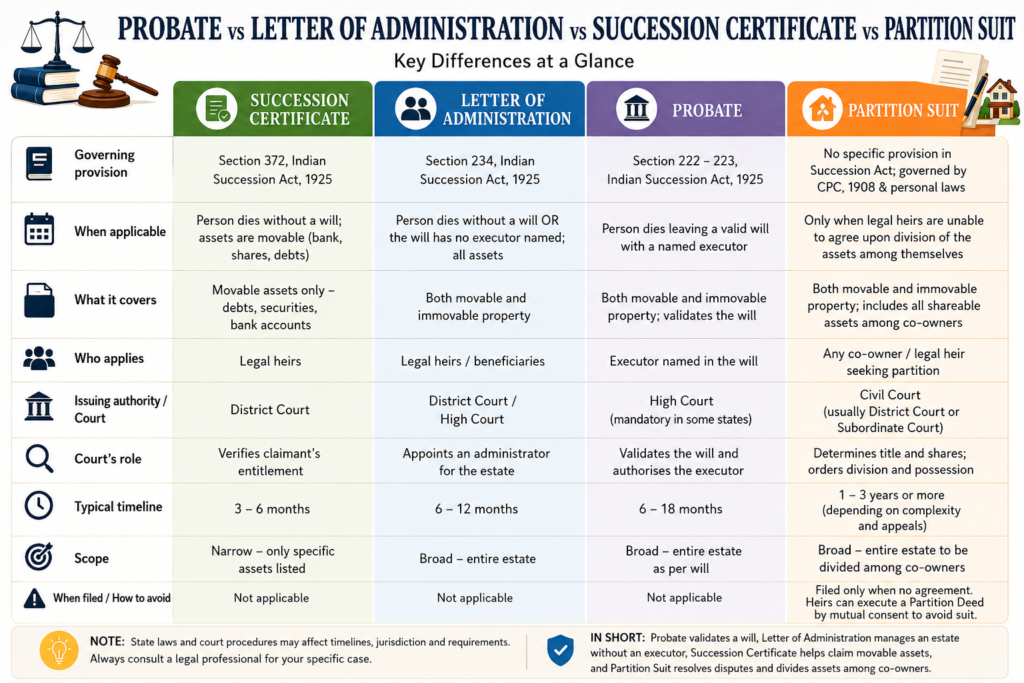
Before applying for a Succession Certificate, you must first identify if you really require it or not. Remember, that Succession Certificate is only granted in respect of movable assets of the deceased person such as Bank Accounts, Shares, Mutual Funds, and other securities and when there is no will of the deceased.
However, if the deceased has a will, or they have immovable assets as well, the scenario completely changes and you may require a Letters of Administration (if there is a will but no executor), file a Probate Case (if there is a will and executor named) or a Partition Deed (if all the legal heirs are in agreement) Partition Suit (No Will and Immovable Property).
You can refer to the image below to understand. However, if this is something that you are not able to understand, don’t worry. You may Contact Us.
Who can Apply?
Under Delhi Law, legal heirs may include children, spouse, and other relations, depending on whether the person belongs to a particular religion or community.
According to Hindu Succession Act 1956, there are mainly three types of heirs namely Class I, Class II, Agnates, and Cognates.
Class I Heirs: These are considered as priority heirs and consist of wife, sons, daughters, mother, and some other relatives.
Class II Heirs: In the absence of Class I heirs, class II heirs become eligible, and the list includes father, brothers, sisters, nieces, nephews, etc.
Agnates and Cognates: Where neither Class I nor Class II heirs exist, then distant relatives are considered eligible.
In relation to Muslims, they have inheritance law that aims at giving share to heirs like children, spouses, and parents. On the other hand, Christians and Parsis adhere to the Indian Succession Act of 1925.
Documents Required for Succession Certificate
Following are the documents required to apply for a succession certificate.
- Death certificate of the deceased person.
- Identity Proof of the deceased person.
- Identity proof of the applicant(s).
- Proof of address of the applicant(s).
- Details regarding the assets for which the certificate is being applied.
- Affidavit stating the relationship of the applicant with the deceased and no existence of any will.
- Initial Court Fees
Step by Step process to obtain Succession Certificate
Step 1: Determine the Correct Court
File the petition in the District Court of the area where the deceased last resided or where the assets are located. Delhi has five main district courts:
- Tis Hazari (Central & West)
- Karkardooma (East, North-East Delhi and Shahdara)
- Saket (South Delhi)
- Dwarka (South West)
- Rohini (North West & North)
- Patiala House (New Delhi District)
For very high-value estates (above 2 crores i.e. 20,000,000/-) the Delhi High Court will have jurisdiction. It is expected that this pecuniary jurisdiction will be revised soon.
Step 2: Hire a Lawyer and Draft the Petition
While you can file in person, it is strongly recommended to engage a lawyer. The petition must include:
- Full name, address, and relationship of the petitioner
- Date of death and last place of residence of the deceased
- Names and addresses of all other legal heirs
- Specific list of debts and securities (bank accounts, shares, etc.) for which the certificate is sought
- A statement that the deceased died without a will (if applicable)
Step 3 : File the Petition and Pay Initial Court Fees
Submit the petition accompanied by all the necessary documents at the filing counter of the court.
Step 4 : Public Notice by the Court (45 Days)
Once the petition has been filed, the court releases a public notice in the local newspaper for about 45 days. This will be followed by any objections that may be received from creditors and other persons claiming ownership.
In case there are other heirs mentioned in the petition, the court also sends them notices.
Step 5 : Objection Period
In case any individual objects (for example if another heir is objecting regarding entitlement), he/she must file their objection during the 45 days. In case there are any objections, the case becomes contested and the time frame will be considerably longer.
Step 6 : Summoning of Witnesses and Final Hearing
If no one has any objection, or after dealing with all objections, the court then summons witnesses from relevant financial institution to ascertain the values of the assets. Once the valuation of all the assets is completed.
Step 7: Payment of Court Fee
After your hearing, the court values the properties and computes the appropriate fee for the court. You have to pay the court fee (through judicial stamps) prior to getting the certificate.
Step 8 : Issue of the Succession Certificate
After paying the court fee, and once the judge is satisfied with everything, the Succession Certificate is finally issued. This certificate will contain details of all debts or securities that you can claim.
Time Duration for and Court Fees of Succession Certificate in Delhi
The fee for succession certificate in Delhi will depend on the worth of the assets in question. Usually, it is determined as a percentage of the asset worth, which is approximately 2%. The fee for a succession certificate Delhi is charged using Court Fees. The entire procedure to obtain a succession certificate may take some considerable time. Normally, it may take about 5 to 7 months, although it can be more than that, depending on several issues such as the number of cases in the court, among others.
- If no objection raised – 6 to 9 months
- If there are objections raised by someone else who inherits 12 to 18 months and even longer.
- In case there is a High Court revision – 2 or more years
The 45 days waiting period constitutes the bulk of the duration. Other factors may include witnesses from the bank and financial institutions not appearing timely and deficiencies in documents.
Conclusion
A Succession Certificate is a legal document that is required by families when they want to access the movable property left behind by a person who dies without making a Will. The process of applying for a Succession Certificate in Delhi entails making a petition in the relevant District Court, publishing notice, establishing the heirs, and paying the necessary court fees.
Although the whole process might take some time, it makes things much easier when dealing with banks, financial institutions, insurance firms, and investment authorities. It is recommended that professional representation be availed for obtaining a Succession Certificate, as any mistake in the filing or procedure may be detrimental to your interests and cause delays.